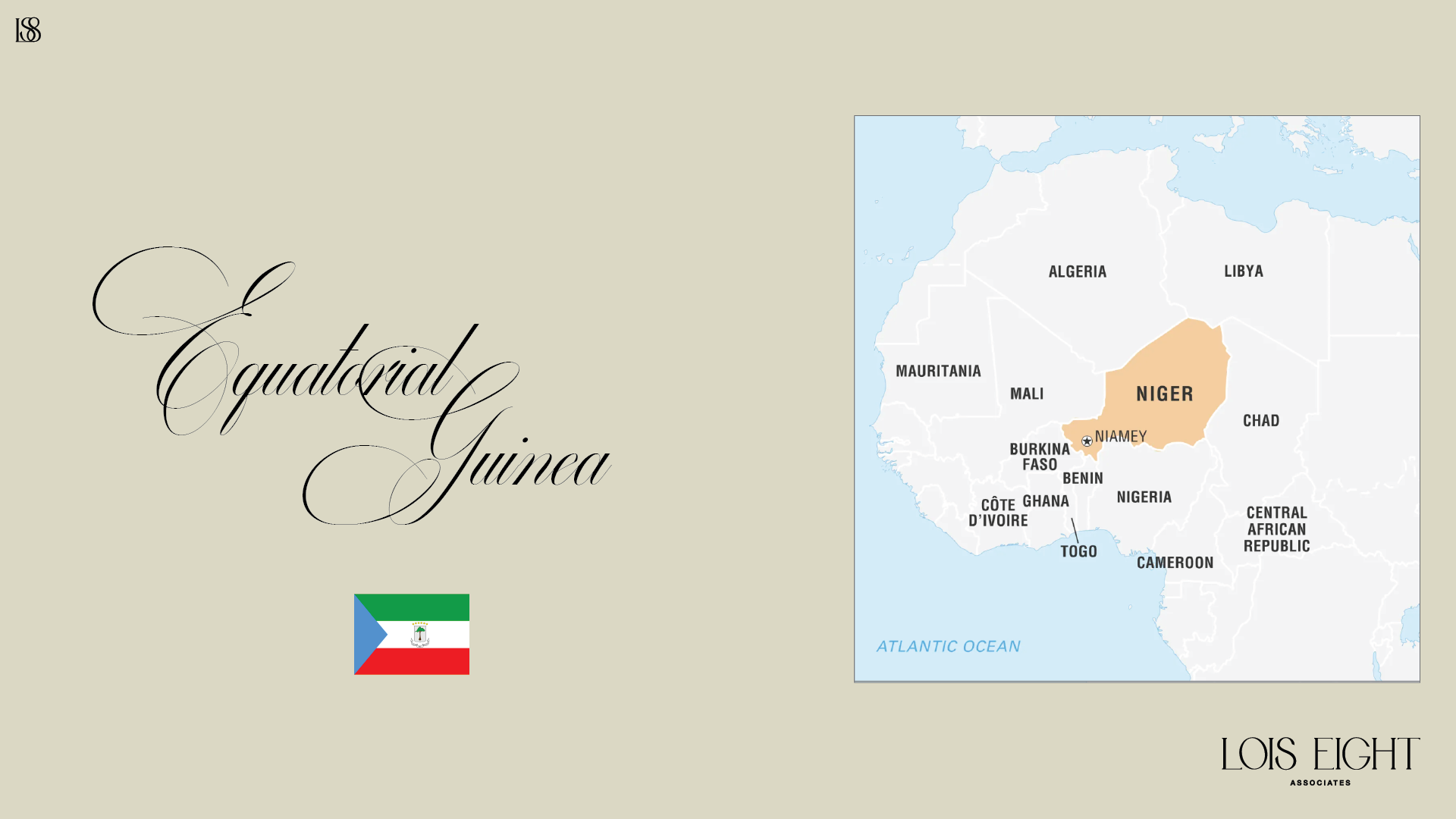
Equatorial Guinea
A Resource Powerhouse Transitioning Into a Diversified Investment Economy
Overview:
Equatorial Guinea is one of Africa’s most resource-intensive economies, anchored by significant oil and natural gas reserves.
Capital: Malabo (current) Ciudad de la Paz (under construction)
Area: 28,050 sq km
Population: 1.6 million
Languages: Spanish, French, Portuguese
Life expectancy: 59 years (men) 63 years (women)
Lois Eight Perspective
Equatorial Guinea presents structured opportunities across four core investment pillars:
Energy & Hydrocarbon Systems
Infrastructure & Urban Development
Tourism & Hospitality Development
Environmental & Utility Systems
Lois Eight focuses on structured capital deployment into resource-backed economies undergoing diversification transitions.
-
Energy remains the backbone of the economy, with strong oil and LNG capacity.
Opportunities include:
LNG production and export infrastructure
upstream oil development and services
downstream refining and petrochemical expansion
renewable energy integration projects
This sector is defined by:
high revenue concentration with increasing diversification into energy value chains.
-
The government is actively investing in national infrastructure transformation, including new administrative and urban centres.
Key opportunities include:
port development and logistics infrastructure
airport expansion and aviation systems
road and intercity transport networks
development of Ciudad de la Paz and urban housing projects
This represents:
a state-driven infrastructure build-out phase supporting long-term economic repositioning.
-
Equatorial Guinea has largely untapped tourism potential, particularly in eco-tourism and luxury segments.
Opportunities include:
eco-tourism resorts and nature-based tourism
coastal and island luxury hospitality projects
hospitality infrastructure in emerging urban zones
travel and tourism service ecosystems
This sector is positioned as:
a long-term diversification lever with high upside potential.
-
As infrastructure expands, demand for structured utility systems is increasing.
Opportunities include:
waste management and recycling systems
water treatment and sanitation infrastructure
urban environmental management solutions
sustainability-linked infrastructure projects
This sector supports:
long-term livability and urban expansion strategies.
-
Equatorial Guinea is positioned as:
a high-resource hydrocarbon economy
a state-led infrastructure development market
an emerging luxury tourism frontier
a diversification-focused investment environment
Its investment thesis is driven by:
resource wealth being systematically redirected into national infrastructure and economic expansion.